
Latest Developments in Solar Shingles and Solar Roofs
Shingling · Panel
Latest Developments in Solar Shingles, Solar Roofs and Solar Tiles
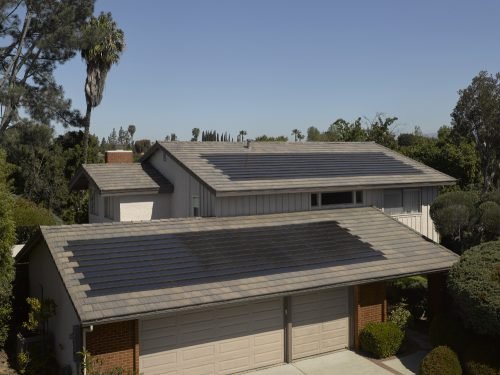
There are many words used to describe unconventional solar PV technologies used on roofs. In the “building-applied” category (basically anything other than traditional solar panels mounted on racks), terms such as solar roofs, solar shingles and solar tiles are becoming more common, particularly after Elon Musk and Tesla announced the solar roof idea in 2016. Although the Tesla solar roof has yet to show a successful rollout beyond a few pilot installations, there are currently many building-applied solar products on the market for homeowners looking for something different from existing solar energy.
One solar panel manufacturing process that has attracted attention recently is “shingling”. Not to be confused with the “solar shingles” used in building-applied photovoltaics, shingled modules cut solar cells into strips and overlap them inside the framed module. The gaps between cells are eliminated, and more silicon cells can be fitted into a single module, increasing power output and module efficiency.
Shingled modules are probably the furthest frontier of crystalline silicon solar development. Without the introduction of dual-junction processes such as heterojunction technology, which combines crystalline silicon with an amorphous silicon thin film to produce a high-power hybrid cell, a shingled module delivers the highest power and efficiency you can get from conventional, undoped crystalline silicon.
Let us look at the basics of shingling technology.
When it comes to building-applied photovoltaics, “solar shingles” and “solar tiles” are often used interchangeably, but a module using shingling technology is actually different from a module using tiling technology.
“Jinko’s Tiling Ribbon (TR) technology is different from shingled modules. There is some overlapping of cells, facilitated by the tiling ribbon,” said JinkoSolar Technical Service and Product Management Director Vikash Venkataramana. “The ribbon is designed to be placed between the overlapping cells to eliminate direct contact between them and remove any concern about mechanical stress. Special encapsulants are also used in the module to reduce mechanical stress.”
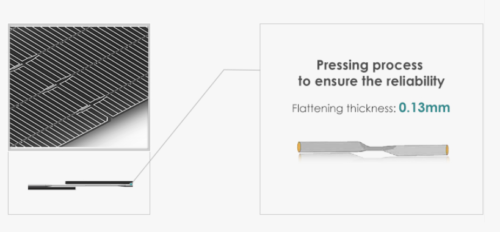
LONGi is experimenting with what it calls “seamless soldering” to eliminate the gaps between cells , a method that appears to behave similarly to Jinko’s tiling ribbon. In Jinko’s case, the flexible round ribbon connecting the half-cut cells is flatter in the overlapping area, allowing the cells to be packed closely together. Jinko’s tiled modules still use nine visible busbars.
“From a manufacturing process perspective, one of the benefits of tiling ribbon technology is its similarity to the conventional half-cell module manufacturing approach,” said Venkataramana. “Both technologies embrace the philosophy of connecting cells with a ribbon through busbars. As Jinko adopts this new technology, we aim to stay flexible and embrace innovation in a rapidly changing technology landscape.”
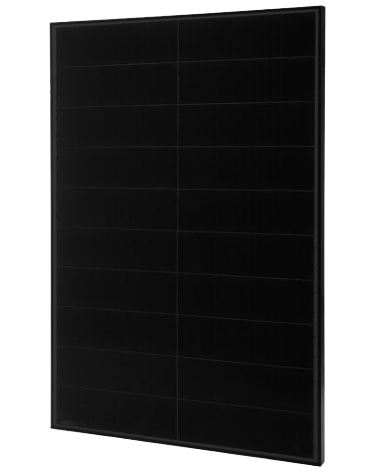
True shingled modules have no visible busbars and the solar cells are cut into five or six strips and joined with an electrically conductive adhesive. Seraphim Solar’s S2 shingled module uses cells cut into sixths, arranged in vertical strings divided into three sections. SunPower’s P-Series modules also use vertically aligned sixth-cut cell strings, but SunPower’s cell strings run the full length of the module.
Solaria, on the other hand, positions its fifth-cut cells in horizontal strips. Sharma said Solaria found that one-fifth of a cell strikes the best balance between maximising power and efficiency and keeping production low-cost. Solaria’s PowerXT modules for the residential market are 400 W, 20.2% efficient and all-black with minimal cell spacing. SunPower’s P-series shingled modules are 350 W and 17% efficient, and have an even smaller area than Solaria’s module range. Seraphim’s S2 shingled line runs at around 355 W and is 19.6% efficient.
There is no real reason to keep solar cells at large square sizes. By cutting the cells in half, gaps can be eliminated and more silicon can fit on the panel. Shingled cell strings can reach the full length of a module without gaps, as in SunPower’s P-series.
“You eliminate a lot of gaps. So you can get more efficiency or higher power from shingling,” said Sharma. “You also take the busbars out of view. Now a much larger amount of silicon surface is exposed, so you collect more power. Anywhere you see a busbar means there are no photons being converted into electrons in that spot.”
By contrast, tiled modules still have busbars. Shingled modules use an electrically conductive adhesive between the top of one cell strip and the bottom of another. This is what connects them, electrically and mechanically, into longer strings; tiled modules do not use this.
Although Solaria is a leader in shingling technology and holds more than 250 patents on the design, the company is not trying to hoard every advance in the technology.
“Our view is that the solar industry is a big industry. We are not trying to be everything to everyone. We are not trying to be the world’s largest panel manufacturer,” said Sharma. “So there is a broad area of the market that we do not serve, which means we can license our technology to about half a dozen companies.”
Meanwhile, Solaria has already shifted its R&D beyond simplification to something else: tandem junction modules.
“If you take a step back, solar panels are becoming more efficient, more cost-effective and more reliable. The technology is already quite remarkable,” said Sharma. “Other energy technologies, fossil fuels above all, will not be able to compete. Semiconductors will take over energy just as they took over computers and mobile phones. This is a better technology with many more levers to pull to increase the efficiency, cost and yield of solar power.”